
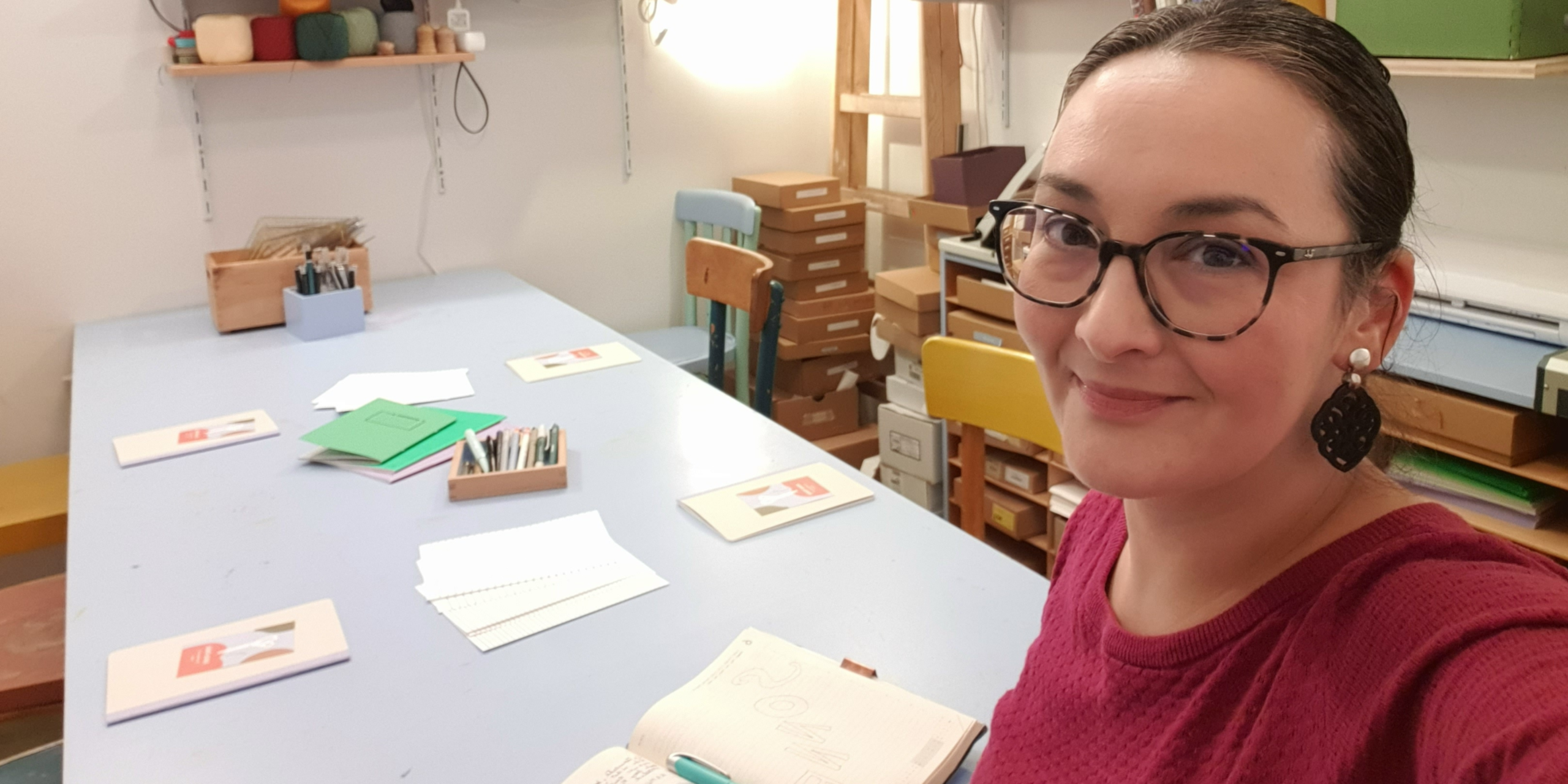
Thinking with a pen – finding creative solutions on paper
Creative problem-solving through writing, visual thinking and paper
Workshop concept · Creative Writing · Visual Thinking · Creative Problem Solving · Analogue Methods
Turning thoughts into something you can see
What if writing could be more than a way of expressing ideas?
For this workshop, I developed a three-hour analogue creative problem-solving format that uses handwriting, freewriting, visual thinking and paper-based methods to make thoughts visible.
The starting point was simple: when a problem remains entirely in our heads, it can feel abstract, overwhelming or impossible to move forward. Putting thoughts on paper changes the relationship we have with them. Once an idea becomes visible, it can be questioned, rearranged, connected and transformed.
The pen becomes a thinking tool.
The challenge
We often try to solve problems by thinking harder.
But some decisions need a different approach: slowing down, externalising thoughts and looking at a question from several perspectives.
The workshop was designed for participants who arrived with a real question, challenge or decision from their everyday life or work.
Instead of receiving a predefined solution, they were given a set of analogue methods to investigate their own topic.
The workshop methodology
I combined techniques from creative writing, visual thinking and creative problem solving into a hands-on process.
Participants worked entirely with paper and pen and moved through different stages:
- 1. Externalise Get thoughts out of the head and onto the page through writing exercises and free association.
- 2. Deconstruct Break a complex question into smaller elements and identify patterns, tensions and connections.
- 3. Reframe Use writing prompts and visual methods to approach the same problem from unexpected perspectives.
- 4. Connect Cluster ideas, create associations and make relationships between seemingly unrelated elements visible.
- 5. Decide Transform the exploration into a concrete, personally developed next step or decision.
The process deliberately alternated between structured exercises and playful exploration.
Why paper?
The analogue format was an essential part of the concept.
There was no laptop, no scrolling and no digital interface. Just paper, handwriting and time to think.
Writing by hand slows the process down. It creates a physical record of thoughts and makes it possible to literally move ideas around, draw connections and see a problem differently.
The paper becomes a space for thinking — not simply a surface for recording the result.
From abstract thought to tangible decision
The goal was not to produce beautiful texts.
It was to create clarity through writing.
By the end of the workshop, participants had worked through a question that had previously existed mainly in their heads and transformed it into something tangible: a clearer perspective, a possible solution or a concrete decision.
The result was personal, handwritten and self-developed.
My role
Workshop concept & design
Creative writing methodology
Exercise development
Workshop facilitation
Visual thinking & analogue methods
I designed the workshop as a bridge between creative writing and practical problem solving, showing how writing can function as a method for thinking, not only as a form of literary expression.
Format
Duration: 3 hours
Language: English / German
Format: In-person workshop
Location: sous bois sous-bois, Neustiftgasse 33, 1070 Vienna, Austria
Participants: Small group
Methods: Creative writing · Freewriting · Visual thinking · Problem clustering · Analogue ideation · Reflective writing
The idea behind the project
In a world increasingly dominated by screens, AI-generated content and constant digital input, this workshop explored a deliberately simple question:
What becomes possible when we slow down and think with our hands?
The project positions writing as a creative, embodied and practical thinking practice — a method that can be used not only to tell stories, but also to understand problems, generate ideas and make decisions.