
Using writing techniques to capture, organise and develop ideas
Workshop concept · Creative Writing · Idea Management · Creative Thinking · Analogue Methods
What if writing could help you manage your ideas?
Ideas rarely arrive when we are ready for them.
They appear in the middle of a meeting, on the train, during a walk — and often disappear just as quickly. Other ideas stay in our heads for weeks, but never become concrete enough to act on.
For this workshop, I developed a practical writing-based methodology for capturing ideas, organising thoughts and turning vague concepts into clear next steps.
The workshop explores writing not as a literary exercise, but as a tool for thinking, planning and creative problem solving.
The challenge
Many people have no shortage of ideas. The challenge is knowing what to do with them.
An idea can remain:
- a sentence in the notes app
- a thought that keeps coming back
- a problem without a clear structure
- a collection of disconnected possibilities
- a project that never gets started
The workshop was designed to bridge this gap: from spontaneous thought to structured idea.
Writing as an idea-management tool
The central premise was simple:
Writing can make thinking visible.
When an idea is written down, it becomes possible to examine it from the outside. It can be expanded, questioned, reorganised, connected with other ideas and eventually transformed into a plan.
I created a series of short, accessible writing exercises that participants could use in different contexts — from starting a project to preparing a meeting or planning the week.
The methodology
The workshop combined creative writing techniques with practical idea-management methods.
Participants moved through a sequence designed to take an idea from its first appearance to a more structured form:
- 1. Capture Learn how to quickly record spontaneous ideas before they disappear.
- 2. Explore Use freewriting and associative writing to develop an initial thought without judging it too early.
- 3. Organise Identify connections, priorities and patterns within a collection of thoughts.
- 4. Clarify Use targeted prompts to define what an idea actually means and what problem it might solve.
- 5. Develop Move from an abstract concept towards possible applications, actions or next steps.
- 6. Build a personal system Create an analogue idea-journaling practice that can be continued after the workshop.
Why analogue?
The workshop deliberately moved away from screens.
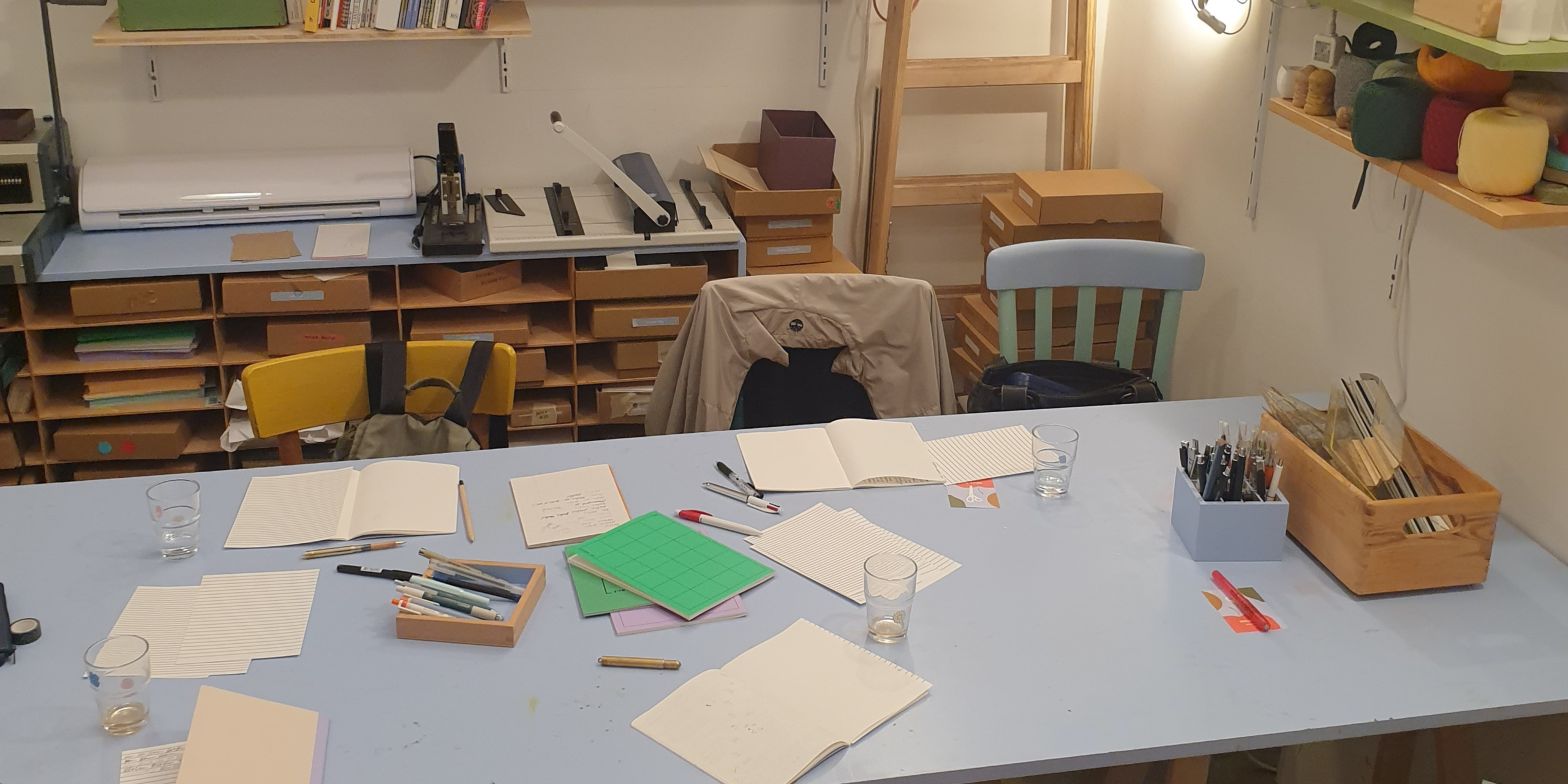
Every exercise was completed with paper and pen. Participants could work with a notebook, loose sheets of paper and different writing instruments.
The analogue approach creates a different relationship with ideas: slower, more physical and less constrained by predefined digital structures.
The objective was not to romanticise handwriting, but to use its flexibility as a creative thinking technique.
From idea to action
This was not a theory-based writing course.
Participants wrote throughout the workshop: briefly, spontaneously and experimentally.
Each technique was designed to be immediately transferable to everyday situations, including:
Project planning
Use writing to define an initial idea and identify the next step.
Meetings
Capture thoughts, questions and potential solutions without losing them in the conversation.
Weekly planning
Turn an accumulation of thoughts into priorities and actions.
Creative projects
Develop ideas without prematurely evaluating them.
Personal reflection
Use writing to understand what deserves attention and what can be let go.
Workshop materials
To make the methodology usable beyond the workshop, participants received a practical toolkit:
- a sous-bois notebook
- a handout summarising the writing techniques
- a template for creating an idea journal
- access to different pens to experiment with analogue writing
The workshop was therefore designed not only as a three-hour experience, but as the starting point for a repeatable personal idea-management practice.
My role
Workshop concept & methodology
Creative writing exercise design
Idea-management framework
Workshop facilitation
Participant materials & templates
My approach was to translate creative writing techniques into practical tools that can be used outside a literary context.
The result is a workshop at the intersection of creative writing, productivity and creative problem solving.
Format
Duration: approximately 3 hours
Language: English, with German support when necessary
Format: In-person workshop
Location: sous bois sous-bois, Neustiftgasse 33, 1070 Vienna, Austria
Methods: Freewriting · Associative writing · Idea capture · Idea development · Reflective writing · Analogue journaling
The concept behind the project
We often think of writing as the final stage of thinking: first we have an idea, then we write it down.
This workshop reverses that relationship.
Writing becomes part of the thinking process itself.
Instead of waiting for a fully formed idea, participants learn to use the page to discover, develop and structure their thoughts.
The result is a simple but powerful principle:
Don’t wait for the idea to become clear. Write until it becomes clear.